The Soap On the Sink
From The Oklahoma Chronicles: A childhood visit, an old bathroom sink, and the kind of love that had already passed through fire.
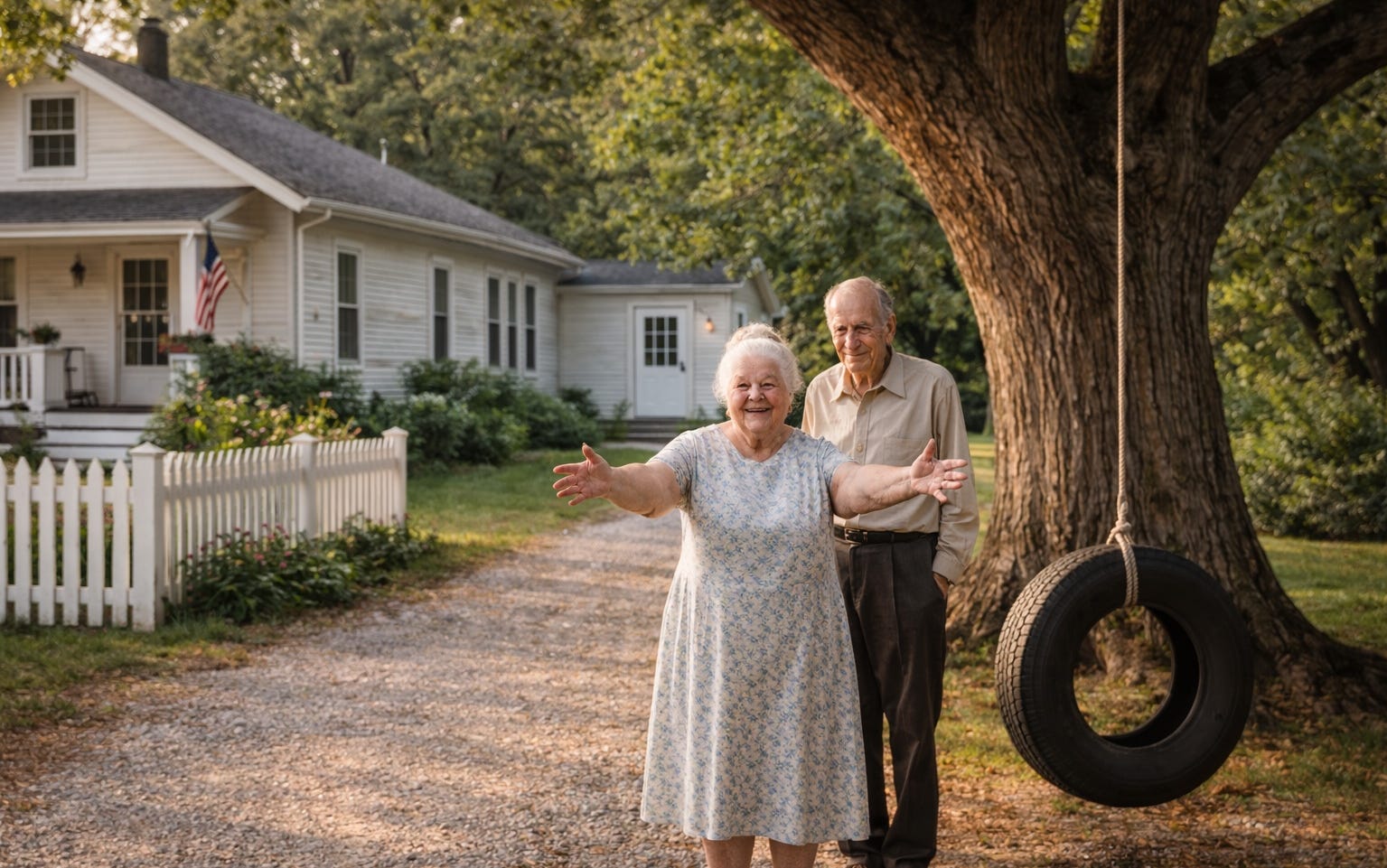
“Come here and let me hug you,” our great-grandmother commanded.
She had a way of causing compliance. We obeyed, and her hugs were strong, stopping just short of crushing each of us in turn, but full of unmistakable pleasure at having her great-grandchildren in the house on a Sunday afternoon.
“You children go play outside while I get supper ready. Great-Grandfather will watch you while I visit with your parents in the kitchen. Your mother used to play for hours on that tire swing.”
She pointed toward it, and we ran at once, each wanting first claim. In the end we yielded to our little brother, whose plea—“Let me go, please”—was too earnest to resist.
The swing hung from a high limb on a long thick rope and required teamwork: one to ride, one to push, though two pushing worked better and three best of all. So we began a grand frolic under the shade of that ancient elm.
I remember her as warm and matronly, but not soft in any yielding sense. Her gray eyes glittered with the intelligence of hard-won survival. Even as a child, I felt she could look straight through the surface of me—past the fidgeting, the little evasions, the momentary innocence—and arrive at some truer accounting beneath. If she found anything wanting there, it was not beyond pardon. But it was found.
What I remember most vividly is her voice calling us in from the yard one Sunday in Cleveland, Oklahoma.
“Wash your hands. It’s time for supper.”
Then, before we tore off toward the bathroom, the added commandment:
“Don’t use Grandpa’s tan lye soap. It’s too harsh. Use the white Lifebuoy.”
That sentence stayed with me. White Lifebuoy? To us children, Lifebuoy was coral-colored, the bar our other grandmother kept, with its medicinal-clean smell—a smell that seemed to belong equally to laundry, mosquito bites, and evening baths. But in Great-Grandmother’s house, even the soap felt older, sterner, nearer the root of things.
In 1905, when oil wells were rising around Bartlesville like some metallic crop, John G. Sisemore brought his wife, Mary Prudence, and their children from Aurora, Arkansas, into that raw Oklahoma town of board sidewalks, dust, mud, and promise. He was a derrick builder, a man willing to climb and hammer and trust his body to height and weather.
Then typhoid fever came for him in 1909, and he died at thirty-three.
Mary Prudence was left with three daughters still at home—Maude, Willie Margaret, and Hazel, the youngest only three. She stayed in Bartlesville and supported them by sewing. Families with means sent carriages to fetch her each morning, and she stitched all day in their homes, then returned to her own and sewed late into the night for her girls. They would not be pitied, and certainly not looked down upon.
She had borne six children and buried three in infancy. When a neighbor’s children died of scarlet fever and some of their clothing was offered to her, she burned every thread for fear of contagion.
Church and home were the twin poles of her life, and cleanliness was more than virtue. It was defense. In summer, the place smelled of roses and hollyhocks. In winter, of wood smoke and baking bread. And always, beneath and through it all, there was the clean, severe smell of soap.
By the time I knew her, the losses had been rendered into presence. She had remarried by then and moved with Hawley G. Cutting to Cleveland, Oklahoma, where they lived in a house that seemed, to my child’s eye, the very emblem of safety: a little home with a picket fence, a shaded yard, and that old tire swing hung from the strong limb of an ancient elm. Cleveland itself sat like a green pause in the harsher Oklahoma landscape, tucked near the Arkansas River among scrub oak hills and hard country. Their place felt seasoned rather than built. Nothing new. Everything settled.
My sisters played there in the shade while Dad took my little brother and me down to the river with Great-Grandfather’s astonishingly long cane poles, worms dug from the yard, and bobbers. We caught a couple of small fish, though the true catch of the afternoon was a story my father told me on the way back.
After World War II, when he came home from the Navy, he and my mother—newly married and with almost nothing—had visited these same great-grandparents while trying to decide where he might use the GI Bill to go to college. Great-Grandmother and Great-Grandfather saw more than was said. Before my parents left, Great-Grandfather pressed fifty dollars on my father for the trip, a substantial gift in 1946. Then, noticing the worn bottoms of Dad’s shoes, he insisted on giving him a pair of good boots as well.
My father cried when he told me that story.
“What I felt in that house was love that had outlived fear and turned practical.”
Then came the summons to wash for supper.

The four of us made a run for the house—more stampede than race—our little brother, all energy and short legs, somehow in the lead. We were nearly through the door when Great-Grandmother stopped us cold.
“Don’t run in the house!”
Some voices adults use with children every day. Others seem to carry the backing of an entire civilization. Hers did.
“Where’s the bathroom?” I asked, in a tone of innocence not fully supported by my breathing.
“At the end of the hall past the bedrooms,” she said. “And don’t lock the door. When it gets locked, it can’t be unlocked.”
That warning achieved what the command had not. We slowed immediately. After one quick look among ourselves, silently agreeing that no one would touch that lock, we proceeded down the hall.
There on the broad old porcelain sink lay the two bars of soap: Grandpa’s forbidden tan lye soap and the approved white Lifebuoy. Neither resembled the bright modern certainty of the Dial soap we knew at home.
One sister lifted the white bar and sniffed it.
“It smells sort of like mint and fresh air,” she said.
Another picked up the tan one.
“This one smells like clean laundry and a candle.”
Our little brother, listening closely, said, “I want the candle one,” and we all laughed.
I was tempted by the outlawed bar myself. But it occurred to me that Great-Grandmother might detect the scent on my hands and know, with that same gray-eyed certainty, exactly what I had done. It seemed unwise to test the limits of either soap or omniscience. So we all used the Lifebuoy.
From the kitchen came the soft drift of old hymns on the radio. It was Sunday, after all. At home we would have been in our own Presbyterian frame, quieter perhaps, a little more upholstered. But Great-Grandmother was Baptist, and to my childish mind that lent her authority a more Old Testament force. She seemed the sort of woman whose religion, if need be, might summon an angel with a drawn sword into the hallway. We simply obeyed.
When we came to the table, washed and hungry, supper was waiting: fried chicken, mashed potatoes and gravy, green beans, sliced tomatoes and onions, squash from the garden. It was not a fancy table, but it had gravity. They seemed very old to us then, our great-grandparents—he frailer, she still radiating energy and vigilance. Together they seemed established, as if age had settled over them the way weather settles into wood.
And the food was glorious.
What delighted us children, though we did not phrase it this way, was that this meal, served by elderly relatives, involved none of the punitive vegetables that appeared elsewhere under the broad banner of “good for you.” No beets, no cabbage, no turnips, no wax beans, no cauliflower, no okra or greens. Here was a table governed not by culinary martyrdom but by benevolence.
What remains with me now is not simply the fried chicken, or the elm shade, or the comedy of four children halted by a mysterious bathroom lock. It is the atmosphere of the place: the hymns on the radio, the picket fence, the old sink, the two bars of soap, the sense that hardship had not embittered this household but seasoned it into something stout and lucid.
My great-grandmother had buried children, buried a husband, feared disease, worked by hand far into the night, and built from all of that not romance but order. Not sentiment, but shelter. As a child I experienced her as formidable. As an older man, I think I know better. What I felt in that house was love that had outlived fear and turned practical. It washed, warned, fed, remembered, and endured. And if I listen carefully, somewhere beneath the noise of years, I can still hear the old hymns from her kitchen and smell the soap on my hands.
Author’s Note
Author’s note: The old hymns on my great-grandmother’s radio are lost to memory now, but “Whispering Hope” comes close to the feeling of them.